
herbal adaptogens stress response is best understood through iHerbMed’s safety-first, systems-biology approach: botanical compounds may support wellness pathways, but they do not diagnose, cure, or replace medical treatment. This article keeps the focus on evidence-informed education, practical safety context, and responsible Canadian natural health guidance.
A scientific review of adaptogens and stress biology: how herbs modulate cortisol, HPA axis regulation, autonomic balance, and chronic stress recovery.
Estimated Read Time: 11–14 minutes
Introduction
Stress is one of the most powerful physiological forces acting on the human body. While short-term stress responses are protective, chronic stress triggers persistent activation of the HPA (hypothalamic–pituitary–adrenal) axis, sympathetic dominance, cortisol imbalance, impaired sleep, mitochondrial dysfunction, immune dysregulation, and widespread inflammation. Over time, these changes contribute to:
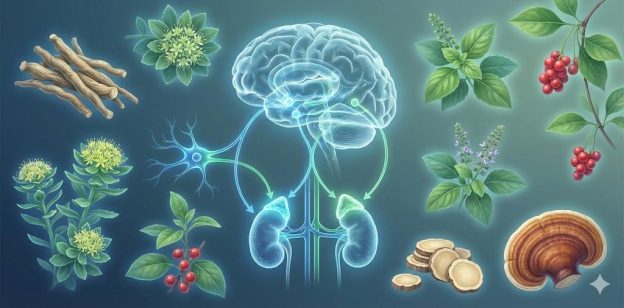
Adaptogens—botanical compounds that increase the body’s stress resilience and homeostatic recovery capacity—have been used for centuries in Ayurvedic, Siberian, Persian, and East Asian medical systems. Today, modern clinical research confirms that adaptogens directly modulate biological stress pathways, including cortisol rhythms, HPA axis signaling, autonomic balance, mitochondrial function, inflammation, and even gene expression.
This article offers a Mayo Clinic–class scientific review of how adaptogens influence the stress response, with detailed physiological mechanisms and clinically relevant applications.
To understand the full stress-inflammation landscape, readers may also explore our articles on
🔗 The Microbiome–Inflammation Axis (microbiome-driven immune regulation) and
🔗 The Herbal–Mitochondria Connection (mitochondrial–stress interactions).
1. Understanding Stress Physiology: The HPA Axis and Autonomic Nervous System
1.1 The HPA Axis: The Body’s Stress Command Center
The HPA axis regulates:
Under chronic stress, the HPA axis becomes dysregulated, leading to patterns such as:
These changes contribute significantly to chronic illness and poor recovery.
1.2 Sympathetic Dominance and Autonomic Imbalance
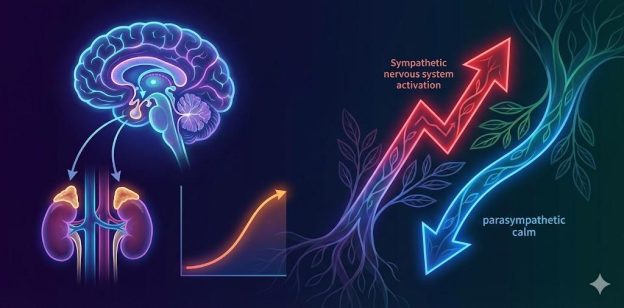
Chronic stress activates the sympathetic nervous system (“fight or flight”), increasing:
Meanwhile, the parasympathetic (vagal) system becomes underactive, impairing:
Our article on
🔗 Botanical Anti-Inflammatory Pathways
explains how chronic sympathetic activation amplifies cytokine production.
Adaptogens help restore autonomic balance, reducing stress reactivity and improving vagal tone.
1.3 How Chronic Stress Worsens Inflammation and Immunity
Chronic stress increases:
As we described in the article
🔗 Herbal Immunomodulation,
stress is a major driver of immunological imbalance.
Adaptogens act as regulators—not stimulants—helping normalize immune patterns disrupted by stress.
2. What Makes an Herb an Adaptogen? (Clinical Criteria)
A true adaptogen must:
Many herbs marketed as “adaptogens” do not meet these criteria.
Below are the adaptogens with the strongest scientific evidence.
3. Evidence-Based Adaptogens and Their Mechanisms
3.1 Ashwagandha (Withania somnifera) — HPA Axis Normalizer
Ashwagandha is among the most clinically studied adaptogens.
Mechanisms
Clinical Evidence
Randomized trials show:
3.2 Rhodiola rosea — The Fatigue and Resilience Adaptogen
Rhodiola is ideal for stress-induced fatigue and cognitive overload.
Mechanisms
Symptoms Improved
It is the best adaptogen for acute stress resilience.
3.3 Holy Basil (Ocimum sanctum) — The Cognitive–Emotional Adaptogen
A profound herb for emotional and psychological stress regulation.
Mechanisms
Clinical Relevance
Helpful for:

3.4 Schisandra chinensis — The Mitochondrial Stress Adaptogen
Schisandra supports both liver function and stress resilience.
Mechanisms
For deeper context, see our article on
🔗 The Herbal–Mitochondria Connection.
3.5 Eleuthero (Eleutherococcus senticosus) — The Foundational Adaptogen
Sometimes called “Siberian ginseng,” eleuthero improves:
Mechanisms
3.6 Reishi Mushroom (Ganoderma lucidum) — The Immuno-Adaptogen
Reishi bridges stress physiology and immune modulation.
Mechanisms
For further reading on immune signaling, see our article:
🔗 Herbal Immunomodulation (stress–immune interactions).
4. How Adaptogens Influence Stress Biology (Detailed Pathways)
4.1 Cortisol Normalization
Adaptogens do not uniformly lower cortisol.
They normalize it:
How they do this:
4.2 HPA Axis Resetting
Adaptogens decrease chronic activation of:
They also support recovery after stress exposure.
4.3 Autonomic Rebalancing
Adaptogens help shift the body from:
This explains improvements in:
4.4 Mitochondrial Protection Under Stress
Stress damages mitochondria through:
Adaptogens improve:
This connects directly to
🔗 The Herbal–Mitochondria Connection.
4.5 Stress-Driven Inflammation Regulation
Chronic stress increases NF-κB and inflammatory cytokines.
For the underlying pathways, see:
🔗 Botanical Anti-Inflammatory Pathways.
Adaptogens lower inflammatory signaling through:
5. Clinical Applications of Adaptogens
Adaptogens are particularly helpful in:
✔ Chronic stress
✔ Emotional exhaustion & burnout
✔ Post-viral recovery
✔ Long COVID dysautonomia
✔ Mild adrenal dysregulation
✔ Sleep disturbances
✔ Stress-induced gut dysfunction
✔ Stress-triggered autoimmune flares (cautiously)
✔ Cognitive overload
✔ Fatigue with poor stress tolerance
Their biochemical effects overlap with inflammation, metabolism, immunity, and mind–body regulation—key themes in iHerbMed’s medical framework.
6. Safety Considerations
While adaptogens are generally safe, caution is necessary in:
Always pair adaptogens with medical guidance in chronic disease.
7. How Adaptogens Fit Into Whole-Body Recovery
Adaptogens work best when combined with:
They are supportive tools—not replacements—for medical evaluation or treatment.
Conclusion
Adaptogens represent one of the most compelling intersections between traditional herbal medicine and modern neuroendocrinology. Their ability to normalize cortisol, regulate the HPA axis, strengthen mitochondrial resilience, reduce inflammation, balance the autonomic nervous system, and support emotional stability makes them uniquely suited for managing chronic stress and supporting recovery.
By integrating adaptogens with lifestyle medicine, nutrition, microbiome balance, and conventional care, individuals can build a more resilient physiology capable of withstanding modern stressors.
For further exploration of related physiological systems, see our companion articles:
📚 References
Herbal Adaptogens Stress Response: practical clinical context
For iHerbMed readers in Canada, herbal adaptogens stress response should be understood as evidence-informed education rather than a promise of diagnosis, treatment, or cure. The most responsible interpretation is systems-based: botanical compounds may influence inflammation, metabolism, stress physiology, microbiome signalling, or oxidative balance, but individual outcomes vary and depend on medications, health history, dose, product quality, and clinical supervision.
Clinical insight: Herbal strategies are safest when they are matched to the person, reviewed for interactions, and used alongside appropriate medical care. This is central to iHerbMed’s approach: Bridging Nature and Medicine.
Safety considerations for herbal adaptogens stress response
Safety first: Herbal products can cause side effects, allergic reactions, and herb-drug interactions. People who are pregnant or breastfeeding, living with chronic disease, preparing for surgery, taking prescription medication, or managing immune, liver, kidney, cardiovascular, neurological, or metabolic conditions should speak with a qualified healthcare professional before using herbs or supplements.
Related iHerbMed resources
- About iHerbMed
- Herbal Insights
- Shop evidence-informed herbal products
- Personalized assessment
- Contact iHerbMed
Evidence-informed references
- NIH NCCIH Herbs at a Glance
- PubMed biomedical literature database
- Health Canada Natural Health Products Ingredients Database
- PubMed search results for herbal adaptogens stress response
Frequently asked questions
Can herbal adaptogens stress response replace medical care?
No. Herbal education does not replace diagnosis, monitoring, or treatment from a licensed healthcare professional. It may help support wellness decisions when used responsibly.
Is herbal adaptogens stress response safe for everyone?
No. Safety depends on the person, medication profile, medical history, product quality, and dose. Interaction screening is important before combining herbs with medications.
How does iHerbMed approach herbal medicine?
iHerbMed uses a science-backed, systems-biology lens that respects traditional botanical knowledge while prioritizing medical safety, responsible language, and individualized guidance.
Medical disclaimer
This article is for educational purposes only and does not provide medical advice, diagnosis, or treatment. Herbal products and supplements are not appropriate for everyone. Always consult a qualified healthcare professional before starting, stopping, or combining herbs, supplements, or medications.