
🌿 Canadian Wild Herbs With Proven Therapeutic Properties: A Scientific Review of Native Botanical Medicine
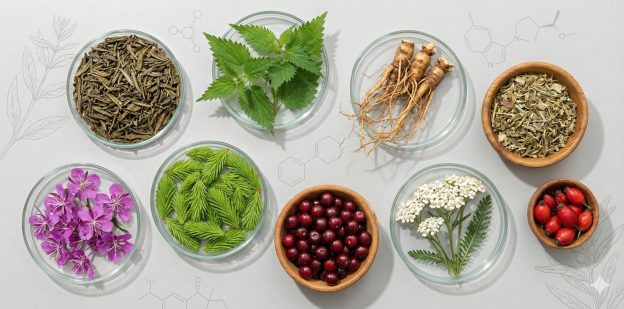
Estimated Read Time: 9–12 minutes
Introduction
Canada’s immense ecological diversity—stretching from Arctic tundra and boreal forests to coastal rainforests and prairie grasslands—has given rise to a remarkably resilient herbal landscape. These plants have adapted to extreme temperatures, nutrient-poor soils, and short growing seasons, resulting in concentrated phytochemical profiles unmatched by many cultivated botanicals.
For thousands of years, Indigenous communities across Canada—Cree, Inuit, Mi’kmaq, Dene, Haida, Coast Salish, Métis, and others—developed sophisticated healing systems grounded in the careful observation of plant behavior, seasonal patterns, and ecological balance. Today, modern phytochemistry and clinical research increasingly validate many of these traditional uses, revealing measurable therapeutic potential in numerous native species.
This article provides a comprehensive, evidence-based review of the most significant Canadian wild herbs. It integrates traditional knowledge with modern scientific findings to offer a clear, non-promotional examination of their pharmacological relevance.
1. Why Canadian Wild Herbs Are Scientifically Significant
Canada’s ecosystems create uniquely potent phytochemical environments. Several factors contribute to this enhanced medicinal profile:
1.1 Harsh Environmental Conditions
Cold climates and short growing seasons stimulate the production of protective compounds, including:
These phytochemicals help plants survive environmental stress—and also contribute to their therapeutic properties in humans.
1.2 Low-Pollution Growing Environments
Remote northern and boreal regions generally show:
This creates cleaner herbal material compared with botanicals grown in intensively farmed regions.
1.3 Deep Indigenous Botanical Knowledge
Indigenous medical systems provide an unparalleled qualitative understanding of:
This knowledge complements modern phytochemical analysis and often precedes scientific discovery.
1.4 Growing Scientific Interest
Canadian universities and research institutes have intensified their study of native herbs, focusing on:
These findings are now shaping a growing field of evidence-based Canadian phytotherapy.
2. Evidence-Based Review of Major Canadian Medicinal Herbs
Below is a scientific review of key herbs native to Canadian ecosystems, including traditional significance, phytochemistry, and current research.
2.1 Labrador Tea (Rhododendron groenlandicum)
Region: Boreal forests, tundra
Traditionally used by: Inuit, Cree, Dene, Innu
Traditional Applications
Phytochemistry
Rich in:
Scientific Insights
Studies suggest Labrador tea may exhibit:
Clinical Relevance
Potential supportive roles include respiratory comfort, inflammatory modulation, and oxidative stress reduction.
Note: Excess consumption can lead to nausea due to ledol content.
2.2 Stinging Nettle (Urtica dioica)
Region: Widespread across Canada
Traditional Uses
Phytochemical Profile
Contains:
Scientific Evidence
Research indicates:
2.3 Goldenseal (Hydrastis canadensis)
Region: Eastern Canada (now endangered; wild harvesting discouraged)
Key compound: Berberine
Traditional Applications
Scientific Findings
Berberine demonstrates:
Sustainability Note
Goldenseal is ecologically sensitive; only cultivated sources should be used.
2.4 Fireweed (Chamerion angustifolium)
Region: Nationwide, especially post-wildfire zones
Traditional Uses
Phytochemistry
Scientific Insights
Fireweed shows:
It is increasingly used in soothing teas for digestive and mucosal support.
2.5 Spruce Tips (Picea species)
Region: Across Canadian forest ecosystems
Traditional Uses
Phytochemical Highlights
Research Findings
Spruce demonstrates:
Historically, spruce prevented scurvy due to its high vitamin C content.
2.6 Chokecherry (Prunus virginiana)
Region: Prairies and boreal forests
Traditional Uses
Phytochemistry
Scientific Findings
Extracts show:
Safety Note: Seeds and leaves must be properly prepared to avoid cyanogenic toxicity.
2.7 Yarrow (Achillea millefolium)
Region: Distributed widely across Canada
Traditional Uses
Phytochemical Components
Scientific Evidence
Yarrow exhibits:
It remains one of the most researched herbs for gastrointestinal cramping and minor skin injuries.
2.8 Wild Rose Hips (Rosa acicularis / Rosa woodsii)
Region: Alberta, northern regions
Traditional Uses
Phytochemistry
Scientific Insights
Rose hips demonstrate:
3. The Role of Indigenous Knowledge in Modern Scientific Understanding
Indigenous plant medicine is rooted in ecological observation, cultural teachings, and intergenerational knowledge transfer. It offers:
Modern science increasingly confirms these traditional applications. However, Indigenous knowledge is not “validated” by science—rather, science supports what Indigenous communities have long known. Integrative research approaches emphasize respect, reciprocity, and cultural acknowledgment.
4. Safety Considerations
Despite being natural products, wild herbs require careful, informed use.
4.1 Potential Risks
4.2 Sustainability
Some species—especially goldenseal—are endangered in the wild. Ethical sourcing and sustainable cultivation are essential.
4.3 Proper Identification
Several Canadian plants have toxic lookalikes; misidentification poses serious risks.
5. Future Directions in Canadian Herbal Science
Emerging areas of interest include:
5.1 Post-Viral Recovery & Long COVID
Canadian herbs with antioxidant and anti-inflammatory profiles may play supportive roles in managing post-viral fatigue and immune dysregulation.
5.2 Microbiome Research
Fireweed, goldenseal, and chokecherry are promising candidates for gut–microbiome interaction studies.
5.3 Aging & Chronic Disease
Rose hips, spruce, and yarrow show potential relevance to immunosenescence and age-related inflammation.
5.4 Climate-Driven Phytochemical Adaptation
Canada’s climate extremes may yield phytochemicals of unique potency deserving deeper biochemical analysis.
Conclusion
Canada’s wild medicinal plants embody the resilience of the landscapes in which they grow. Through a combination of Indigenous knowledge and contemporary phytochemical research, herbs such as Labrador tea, stinging nettle, goldenseal, fireweed, spruce tips, chokecherry, yarrow, and rose hips are increasingly recognized for their therapeutic potential.
While these botanicals are never substitutes for medical care, their actions—ranging from antioxidant defense and inflammation modulation to respiratory, metabolic, and digestive support—make them valuable components of integrative health frameworks. Ongoing research continues to expand our understanding of how Canadian wild herbs can contribute to evidence-based botanical medicine, particularly in the context of chronic illness and recovery.
📚 References
Arnason JT, et al. Phytochemistry of traditional Canadian medicinal plants. Journal of Ethnopharmacology.
Turner NJ, et al. Traditional ecological knowledge of medicinal plants in Canadian Indigenous communities. Journal of Ethnobiology.
Grace MH, et al. Influence of environmental stress on polyphenol content in wild plants. Journal of Agricultural and Food Chemistry.
Hudson JB. Applications of the phytomedicinal agents of North American plants. Canadian Journal of Microbiology.
Coppins BJ, et al. Phytochemistry and bioactivity of Rhododendron groenlandicum (Labrador tea). Planta Medica.
Upton R (ed.). Stinging Nettle Leaf and Root Monograph. American Herbal Pharmacopoeia.
Chrubasik JE, et al. Evidence of stinging nettle for musculoskeletal pain. Phytomedicine.
Mittman P. Randomized double-blind trial of freeze-dried nettle for allergic rhinitis. Planta Medica.
Lichius JJ, Muth C. Urtica dioica root extract in the treatment of benign prostatic hyperplasia. Phytomedicine.
Brown PN, et al. Goldenseal (Hydrastis canadensis): pharmacology and clinical applications. HerbalGram.
Yin J, et al. Efficacy of berberine in type 2 diabetes mellitus. Metabolism.
Kuznetsova SA, et al. Antioxidant and anti-inflammatory potential of Chamerion angustifolium. Journal of Ethnopharmacology.
Hjältén J, et al. Antimicrobial and anti-inflammatory properties of spruce extracts. Journal of Ethnopharmacology.
Hosseinian FS, et al. Phenolic composition and antioxidant capacity of chokecherry. Journal of Food Science.
Benedek B, et al. Pharmacological profile of Achillea millefolium. Current Pharmaceutical Design.
Patel S. Rose hips as a functional food: phytochemistry and health benefits. Journal of Functional Foods.
Rossnagel K, et al. Rose hip powder in osteoarthritis: a systematic review. Scandinavian Journal of Rheumatology.